

In this month's Money & Mischief, Steve Rowe aims to up-end your beliefs that maybe, just maybe, are preventing you from achieving great things!

This month we are taking about insurance… Yawn!
Stifle your yawns dear reader, we are going to review how great this thing is and why everyone should have some.
You may be thinking
“You come from nothing, you're going back to nothing, what have you lost? Nothing!"
Eric Idle - Always look on the bright side of life
Which is a very insouciant way of looking at things. The flip side would be:
“Hey, everything you’ve ever worked for, for you and your family, can vanish! Including your retirement dreams and standard of living you worked so hard for”
Steve Rowe – Always look on the dreary side of life
This song was less widely known and a less popular pastiche of the original. But worth understanding the sentiment.
What is insurance?
In essence, insurance is something to help with the management of risk. This applies to all kinds of insurance but specifically in financial planning terms we are thinking of life and health insurance.
Life insurance: temporary or permanent. You die, and payment is made to your family to look after them as you are not longer able to.
Critical illness insurance: pays a lump sum in the event of you suffering a specific illness, to cover the cost of treatment / time off work or adaptations to your home or other requirements you may have.
Income protection: protecting your ability to earn money, income protection is a short or long-term provision of income whilst you’re unable to work due to illness or disability. Think ‘sick pay’.
The History of Insurance
It’s been around a lot longer than you think! There was an early form of life insurance in Ancient Rome where there were ‘burial clubs’, which covered the cost of funerals and helped survivors out financially.
Insurance in other areas goes back a lot further. For example, the ‘Code of Hammurabi’ from ancient Babylon in around 1650 BCE where loans for shipments were forgiven if the cargo was lost at sea. It was known as ‘Bottomry’ not because the cargo reached the bottom of the sea, or that insurance salespeople were seen in a bad light, but because it insured the bottoms of boats.
The Three Pillars of Insurance
To fully grasp how insurance works, it is best defined through three core economic mechanisms:
- Risk Transfer: You legally shift the financial burden of a potential catastrophe (like a house fire or car accident) to a third party (the insurance company) in exchange for a fee.
- Risk Pooling (The Collective Pool): The insurance company collects premiums from thousands of independent policyholders who face similar risks. This creates a massive pool of money.
- The Law of Large Numbers (Predictability): By looking at a huge group of people, actuaries can use maths to predict roughly how many accidents will happen each year. While the insurance company doesn’t know who will get into an accident, they know exactly how much money they need in the pool to pay for the few who do.
What does this look like in real life
Imagine 1,000 people each own a car worth £20,000. Every year, around 14 of those cars will be written off. Nobody knows whose car it will be, but statistically the insurer knows about 14 losses are likely. Replacing those 14 cars would cost £280,000 in total (£20,000 × 14).
Spread across all 1,000 drivers, that's £280 each. Add some costs and profit, and the premium might be around £320 a year.
For most people, finding £20,000 after an accident would be incredibly difficult. £20,000 could represent a year's income.
Paying £320 a year, however, is manageable.
That's the value of insurance. It turns a potentially life-changing one-off loss into a predictable, affordable monthly or annual expense.
To me, that's a very good trade-off.
As a nation, what do we insure?
That’s for cars; 80% of people have car insurance. I guess the others don’t own a car, as it’s a legal requirement! But of course there are those that do have cars and don’t insure them.
Similarly 80% or people have home insurance and that rises to 96% if you’re a homeowner.
It seems we are very good at insuring our possessions, but not so great on insuring the thing that generates the money that pays for all those things in the first place!
You!
"The things you own end up owning you"
We worry about the things that we own, can see, and have worked so hard for, but not the thing that earns the money to do so. That’s everyone, with their ability to earn money through work.
Here are the percentages of people that have the following covers:
- 30% Life insurance
- 14% Private medical
- 10% Critical illness
- 9% Income protection
I’m one of them, I’ve got all four! Plus I’ve got 3 of those for all my staff. I’m a business owner and I am protecting:
- My ability to earn money at work by looking after my marvellous clients
- If I’m ill I need money to pay people to do it for me whilst I am off so I have a business to come back to
- If I die I need to ensure the business can continue without me, and my wife will have enough money to live on
I read a great analogy once and I can’t remember from whom so cannot cite it:
“If you owned a machine in your house that printed money that was legal tender, you would insure it against breakdown”
Well, you do have one of those machines... it’s you! Your body and mind have the ability to earn an income that can be taken away if it breaks down or goes caput.
Yet most of us don’t do it. Why is this?
Putting it off isn’t a good idea either.
"Buying life insurance is like fixing a leak in your roof... The longer you wait, the more expensive it gets."
For those of you that don’t have these covers, it may be that you do not need them! It may be you have retired and have more money than you are ever going to spend. We would have told you that.
But, you should still insure:
Your health - through Private Medical Insurance. Yes, the NHS will be there for you, but if you can get checked in and checked out more quickly and in more comfort, then all the better!
Your life - This is about covering the inheritance tax bill you will be liable to. If you can get ‘whole of life’ insurance it is definitely going to pay out as long as you pay the premiums. In our calculations, this is, for most people, much more likely to mean your family are wealthier than if you didn’t have it. So, because the probability is on the side of having the insurance, you should do it.
For those of you that are still sceptical, here are a few different ways of thinking about life and health insurance:
Life insurance isn't really about money.
- It's about your family being able to stay in the house they love.
- It's about your partner not having to worry about the mortgage while they're grieving.
- It's about your children being able to continue their education and their lives without financial uncertainty.
- The money is just the mechanism. The real purpose is love.
The Gift You'll Hopefully Never Need
- It's a gift people receive only if something goes wrong.
- But when families need it, it can arrive at exactly the moment they need support most.
- Sometimes the best financial decisions are the ones that never become relevant.
Legendary life insurance agent Ben Feldman famously stated:
"Put me on your payroll. The day you walk out, I'll walk in and pay your bills."
Buying Peace of Mind, Not Insurance
People think they're buying a life or health insurance policy that’s a bit of paper they will never see the benefit of.
They're not.
They're buying:
- Confidence
- Security
- Options
- Reduced stress
- Protection for the people they care about
The paperwork is just the wrapper.
"I do not sell life insurance. I sell money. I sell dollars for pennies apiece. My dollars cost 3 cents per dollar per year."
Private Medical Insurance: Buying Time
People often say money can't buy time. Private medical insurance is one of the few financial products that can.
Shorter waits. Faster diagnosis. Quicker treatment. Less uncertainty.
Ultimately, it's not buying healthcare. It's buying back days, weeks or months that might otherwise be spent waiting.
Your Family's Emergency Fund on Steroids
People often assume that insurance is for those with limited wealth. But many affluent families still choose protection because it protects plans, not just bank balances.
The purpose isn't simply replacing income, it's preserving choices.
Financial Planning Is an Act of Care
At Lucent, we spend much of our time helping people build wealth. But looking after the people you love isn't just about investing.
Sometimes it's about putting safety nets in place.
Protection planning isn't pessimistic. It's optimistic.
It's saying:
"The people I care about matter enough for me to make plans today, even for events I hope never happen."
Insurance
It can seem like a voluntary cost, or something that will never be needed. It can seem like it’s not worth it because ‘insurers don’t pay out’, even though over 97% of cases are paid out.
But here’s what you don’t see:
The difference between a widow broken with grief that will receive a generous life insurance payment and those that don’t - where we are instead discussing moving to a smaller home to release money, cutting back expenses, and fear and uncertainty over their financial future.
Come and say those insurance denials after having sat in those meetings, I dare you! I double dare you! Say it to my face after that meeting and you’ll get a slap around the chops!
The families that end up wealthier because of the insurance, despite living a long and healthy life! Because it raises the minimum floor on your finances.
We see clients about to make frankly, terrible decisions around their money. Many of these are around insurance costs. Yet, by the same token some will not do the investment recommendations we make that would make the money that would pay the insurance! We know there are lots of psychological reasons for this, we get it. You’re human, we make loads of decisions based on rules of thumb. But those are often actively keeping you down and we want to stop that. Our job is help you make better decisions. Next time it’s recommended, stop the immediate ‘no’ reaction and let’s delve more deeply into it, for your own sake and for the ones you love.
P.s. before you start thinking “yeah you would say that Steve, your company makes money from insurance policies” I’d like to point out how incredibly tedious they are to do. It’s not fun for us! Going through applications and hearing about your illnesses, venereal disease, polyps and fungal infections is something we would rather not do! I’m a financial planner -I want to make a graph and do some number analysis.
We do it because it’s better for you.
What have we been up to?
Some of the things we have been working on this year are starting to come to fruition. It’s always nice when this happens and you see the results from the hard work we have put in.
Community Support
We want to be a force for good in the local community and the world too! We raised some money to get a sand pit and mud kitchen installed at Greswold Primary school in Solihull. It was lovely to receive the cards the kids made us and the happy faces it produced. Also, since they are going to be using it to learn about ‘volumes’ and maths, it’s good early training for the next generation of Lucent Financial Planners! Think long term in investing and career development…

Uniquely Wired Network
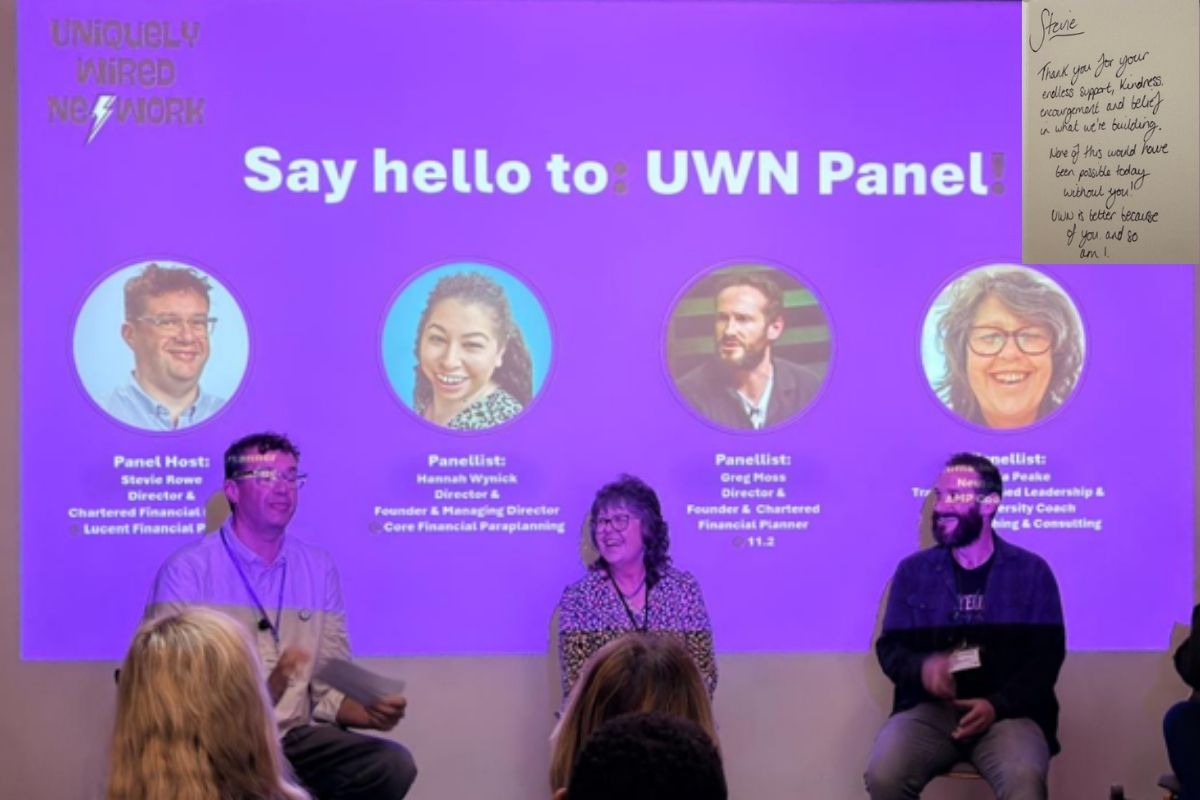
We’ve been involved with helping UWN establish and put on their first event. This is about helping neurodivergent people in financial services become more seen, and to get their unique abilities harnessed for the greater good! Also, for neurodivergent clients of those companies to be able to seek the advice they need in a manner that resonates with them more.
Winning awards
We picked up two gongs at the Money Marketing awards.
One for best use of AI In a Financial advice firm. We are trying to enhance our services and client experience using AI.
The other, and the one we are most proud of is for Small Advice Firm of the Year
Below is a picture of Jasmine and I picking up the award. We also picked up a few lemon martinis which were very tasty 🍸 and my face seems to have turned red like some old lush.

Juggling Mind and Money
In episode 48, Jess and I discussed the ‘money stories’ that we inherit and why they still run our finances. ‘Money Stories’ are the scripts that run through our mind and how we make quick decisions, the ‘rules of thumb’, or in behavioural science terminology the ‘heuristics’.
Many of these are in play when thinking about insurance, here are some examples:
- They never pay out anyway (97% claims are successful! That’s a funny kind of ‘never’)
- It will never happen to me (1 in 3 suffer cancer, heart attacks or a stroke in their lifetime, and everyone dies)
- They can take care of themselves (they’re 9 years old!)
Here’s Jess with her claw!

It’s coming up to our 50th episode soon and we have got some good people coming on, including Robin Powell, journalist and latterly evidence based investment expert - watch this space for that one!
Variety Night
This is for clients only. We have hired the Studio at the Core Theatre in Solihull to showcase different things people can do on retirement… or any other time quite frankly!
It’s hosted by the magician Ben Hanlin of TV stardom and is sure to be an entertaining, laugh-filled evening.
.jpg)
Unfortunately, due to health issues one of our other guest stars has had to drop out... but fear not, dear clients, we always have a plan (our job title is made up of ‘planners’ after all!).
Either:
The Lucent Financial Planning Am Dram Club will step up
Or, and preferably...
One of you will showcase your talents and hobbies to everyone. If you are involved in some kind of:
- Dancing troop
- Music of some kind
- Comedy
Then get in touch... this is your chance to appear in front of over 100 people that are gagging to be entertained, and we'd love to have you!
Until next time, my friends, enjoy yourself, it’s later than you think.



.jpg)